
Liminal Spaces

This post is a bit more 'out there' than my usual. While I was absently scrolling through a social media feed one evening, I ran across some images fitting the description of 'liminal space.' The term describes art, places, or scenes that evoke a feeling of being in-between, such as between past/present, busy/quiet, nature/structure, here/there, indoors/outdoors, or used/abandoned. It may also be represented by transitional elements like bridges, roads, corridors, or thresholds.
Liminal spaces often feel a little 'off,' as if something either just happened or is about to happen, building anticipation or uncertainty. Such images can be more about the mood that's created than the place itself. They can feel like suddenly being confronted by a memory or a

dream that feels a little uncomfortable. And it struck me that many of my photographs fit that definition, too. It's what this post is about.
When I was reading the definition of liminal space, "Daddy Sold the Water Rights" was the first image that came to mind. It's my photo of an abandoned farmhouse (above) located in a rich farming valley, but the house itself is surrounded by dried, unusable fields. It's become one of my top sellers and has been featured in several juried shows, probably because it captures that sense of loss, of something that's now gone for good. While editing it, I imagined one of the children, now grown, visiting the place years later and writing to her sister something like: "Hey Sis! We stopped at the old farm on our way through Colorado. It looks so lonely now. The fields are nothing but dirt and tumbleweeds. Remember how we used to drive Mom crazy running up and down the stairs? And how sad we all were when we had to move away? It almost felt like the place misses us, too."

I could see myself having lived somewhere like that.
Another piece that came about from the sales of water rights is this one of the grain elevator at Simla, Colorado, shot in golden hour light. Since farming has literally 'dried up' in that area, many buildings have been abandoned and left to slowly fall apart. Both scenes capture the liminal space between activity and usefulness, and now, abandonment and decay.
A frustrating liminal space among my images is "At the Corner of Love and Abandonment." It looks too industrial and worn to fit the sentiment stenciled on its side, but there it is, large and

bold, challenging us to figure out its story. Is the building still in use? Which space does it fit: past/present, used/abandoned, here/there? Was there a reason for the stencil, or was it simply the whim of a moment? I've never been able to figure out the story this image wants to tell, and because of that, I'll sometimes find myself just... contemplating it.
An example of the threshold type of liminal space is "Pretty Little Bridge," which pictures an implied pause before beginning the actual transition from one side of the water to the other. I

gave this photo a retro 1960's film look, matching the time when the bridge was built, which intensifies the feeling of being in both the past and the present; here but looking over there; having a crossing point but not using it yet.
Additionally, this work incorporates leading lines. The bridge is the focus that carries the eye up and over the water, then drops it back down to the shore on the far side and along that shoreline to the point where the view is brought back to this side of the bridge by the shrub at the far left. It's possible, but maybe a stretch, to say the eye would be led back up the path, then up the hill between the rabbitbrush tops and the dark
shadow of the shrub at the foot of the bridge, to start all over again.
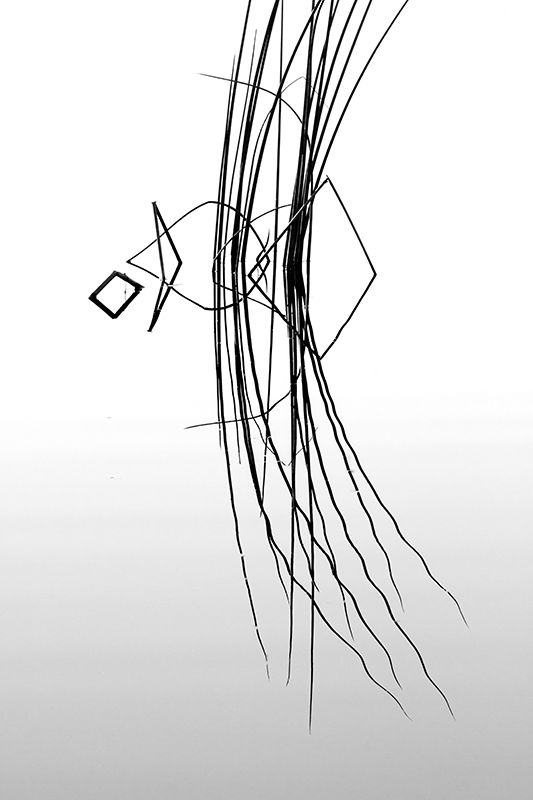
Another type of liminal space is that which is slightly dreamlike -- sort of a passage between imagined and real. "Runic Reflections" is a semi-abstract image in my portfolio that seems to capture attention. At first glance, it's just reeds and water, but the more you look, the lines and shapes begin to feel like an ancient script; they're familiar enough to suggest a language, without being quite legible as one. It's seen within a space that's neither a a straight landscape nor pure abstraction.
Some time ago, I revised this one into a monochrome image to remove dull colors that didn't lend anything to the composition, and later re-worked it into its current high-key form. When I did that, it strengthened the sharp lines and angles of the focal point just above center so that the feeling of partly understood language became clearer.
So, what do you think? After this short tutorial on liminal spaces, I hope you'll be more aware of them in your own life. As a challenge, I'd love for you to search my website for additional liminal spaces that I've captured in my travels. As always, feel free to pop a question, comment, or critique into the Comments section, or email me using this link: Contact
Supporting an independent artist (with an off-kilter take on life) is a great way to add unique art to your personal spaces! Check out more of my work and note your favorites at https://www.denisedethlefsen.com/


Comments